

Blade Sharpening
From the home cook's chef's knife to a hunter's field knife, a landscaper's mower blade, or a stylist's shears — we bring a true edge back, on your schedule.
Kitchen & Hunting Knives
A Long History
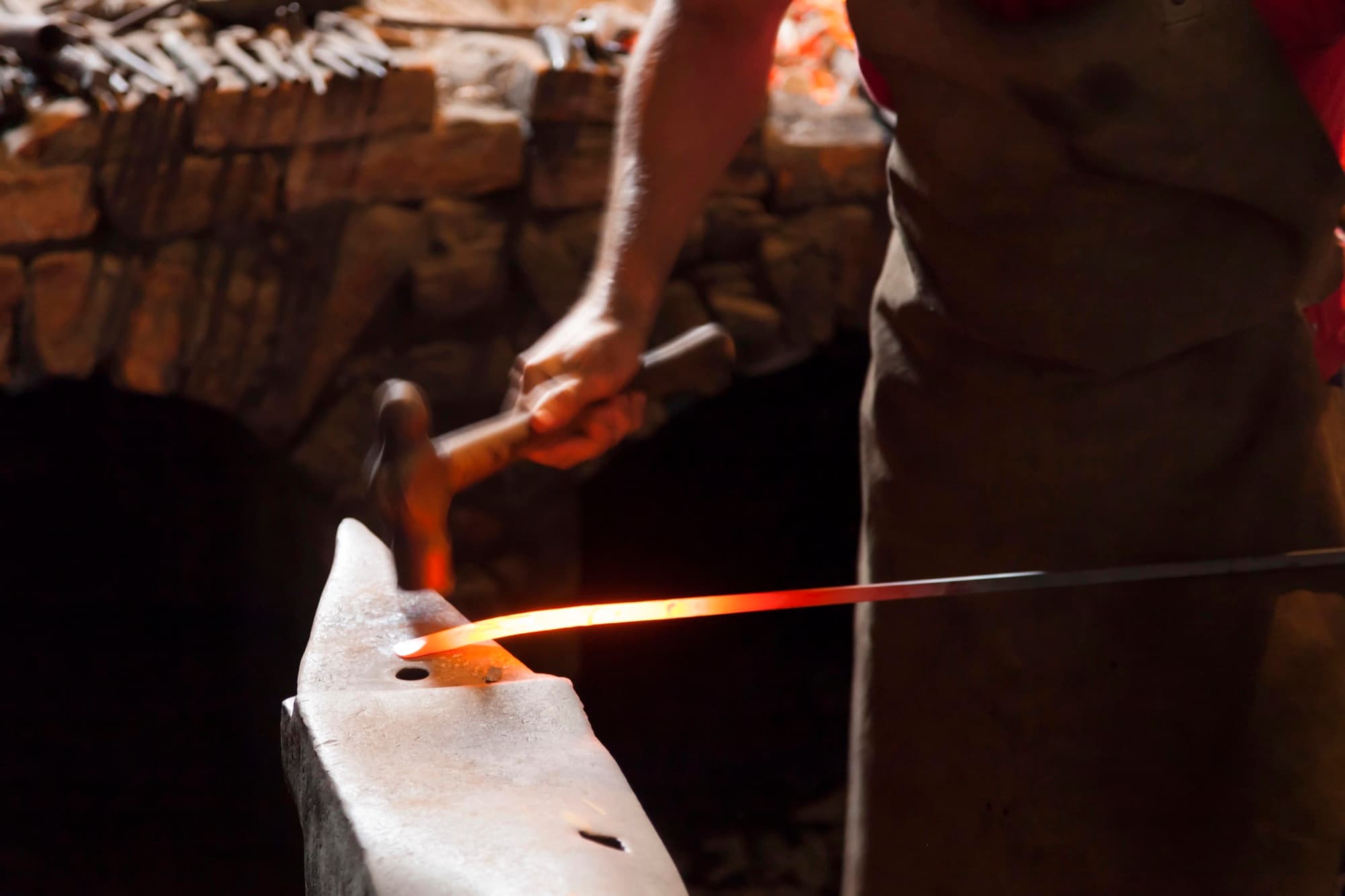
Humans have been chasing a sharper edge for a couple million years — first by knapping flint and obsidian, then casting bronze, then working iron. The steel knife as we know it is a comparatively recent arrival, but the instinct behind it hasn't changed: a dull edge is a tool that's stopped doing its job.
Every culture that worked metal built its own blade tradition — layered steel in a Japanese kitchen knife, a full tang on a European hunting knife. Different steels, different grinds, same sharpening physics: remove metal at the correct angle on both sides of the apex until the two surfaces form an edge that's thin enough to cut.
The Evolution of Knife Sharpening
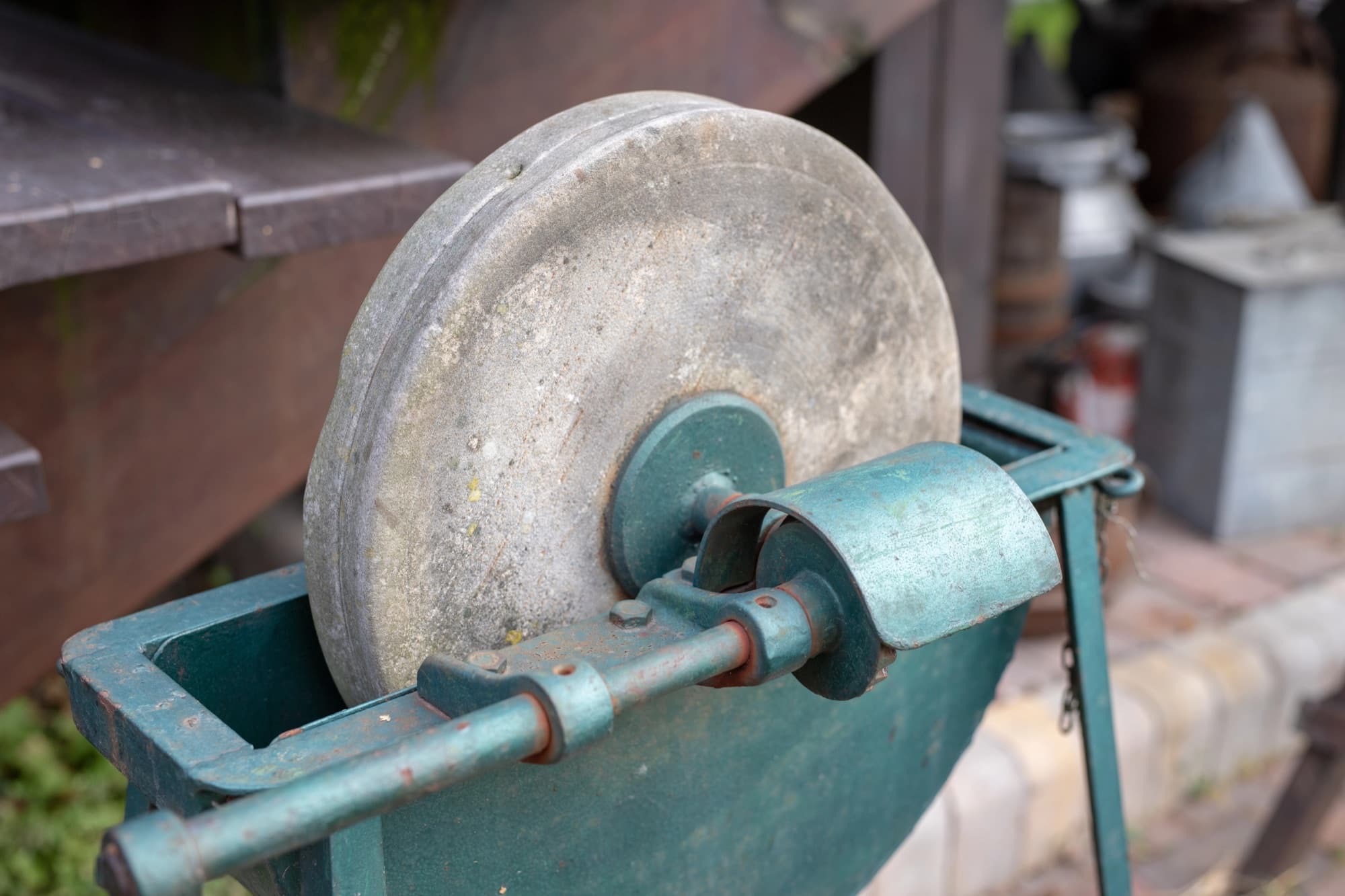
For most of that history, knife sharpening meant a natural stone and elbow grease — a whetstone, a strop, maybe a treadle-powered grindstone turning through a water trough to keep the steel from overheating. It produced a good edge, but a slow and inconsistent one; results depended entirely on the hand doing the work.
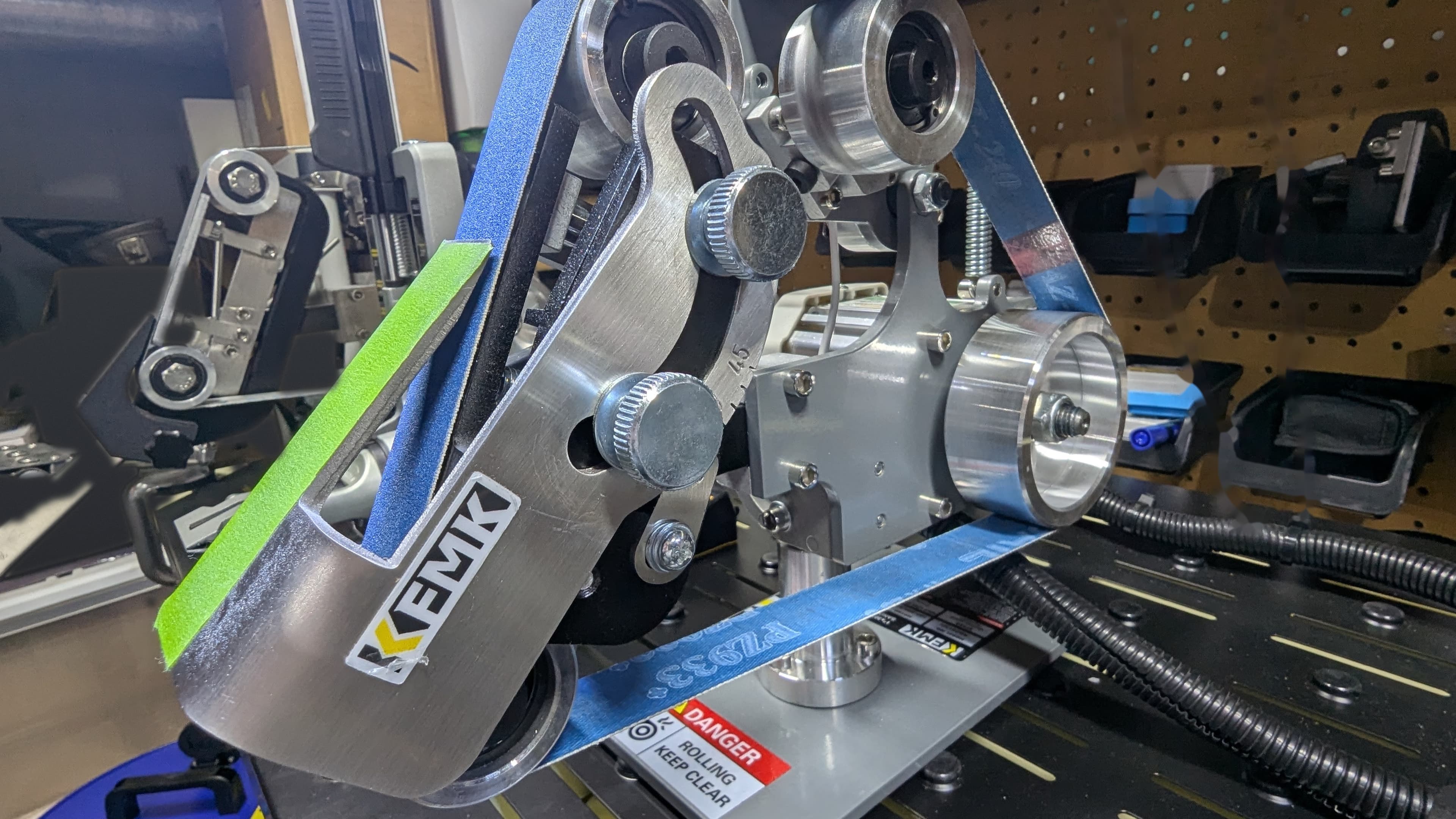
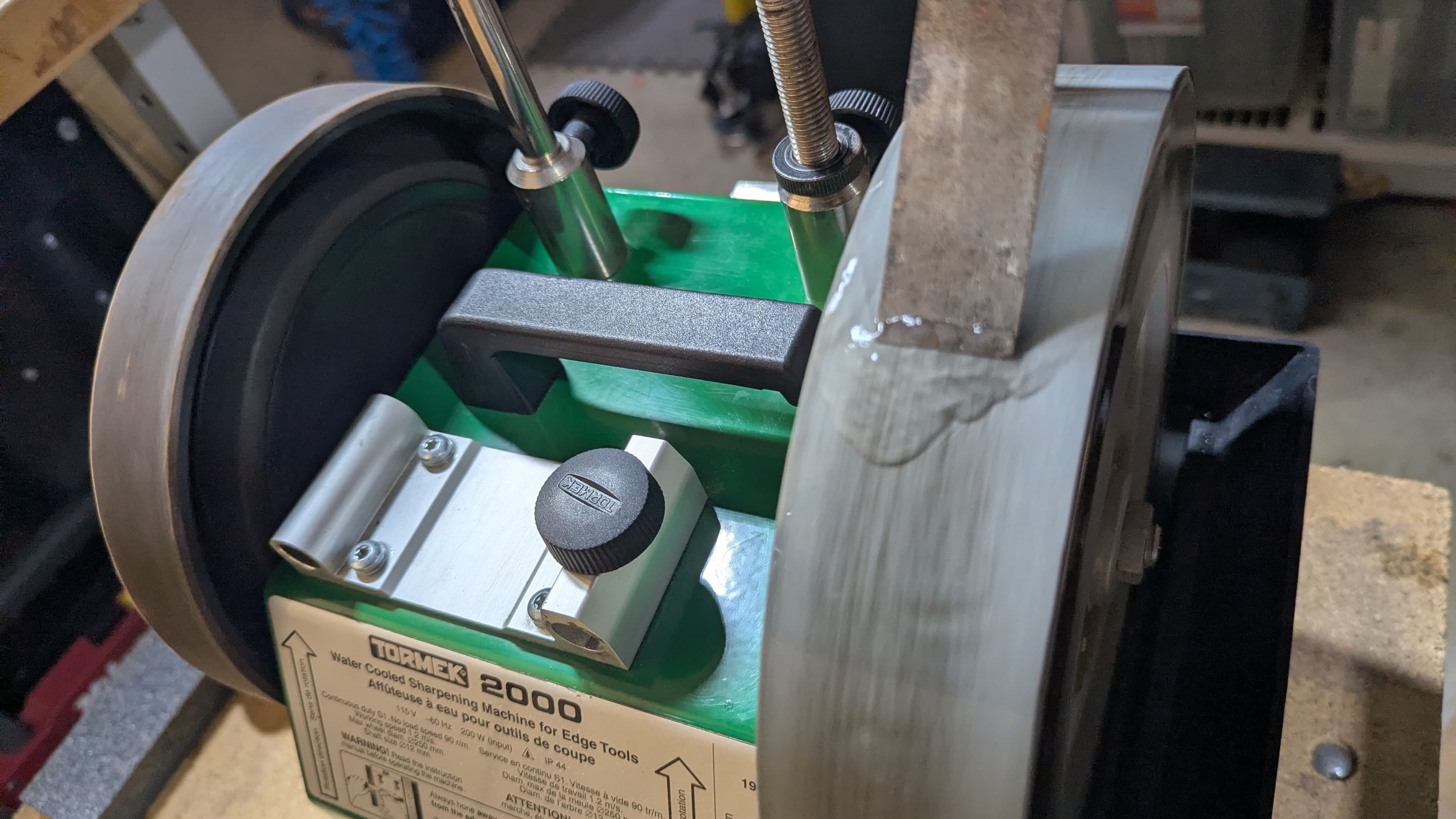
Modern sharpening obeys the same physics, but the tools have changed. We work with diamond-stone systems, fixed-angle jigs, variable-speed belt sharpeners, and water-cooled Tormeks — some of our equipment can hold an angle pass after pass, others still require a steady hand. The stone hasn't disappeared; the technologies around it have got a lot more precise.
Salon, Barber & Groomer Shears
A Long History
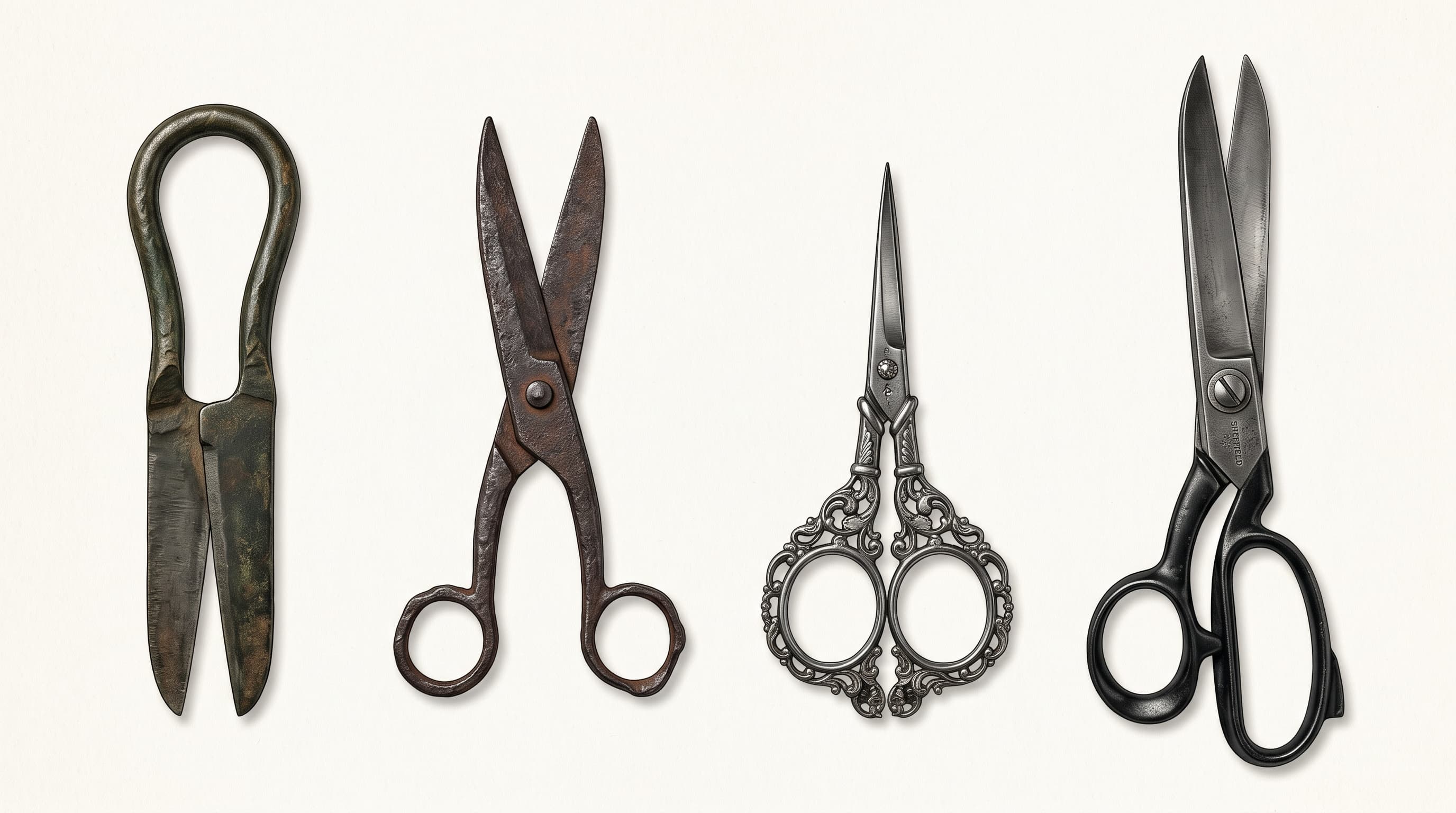
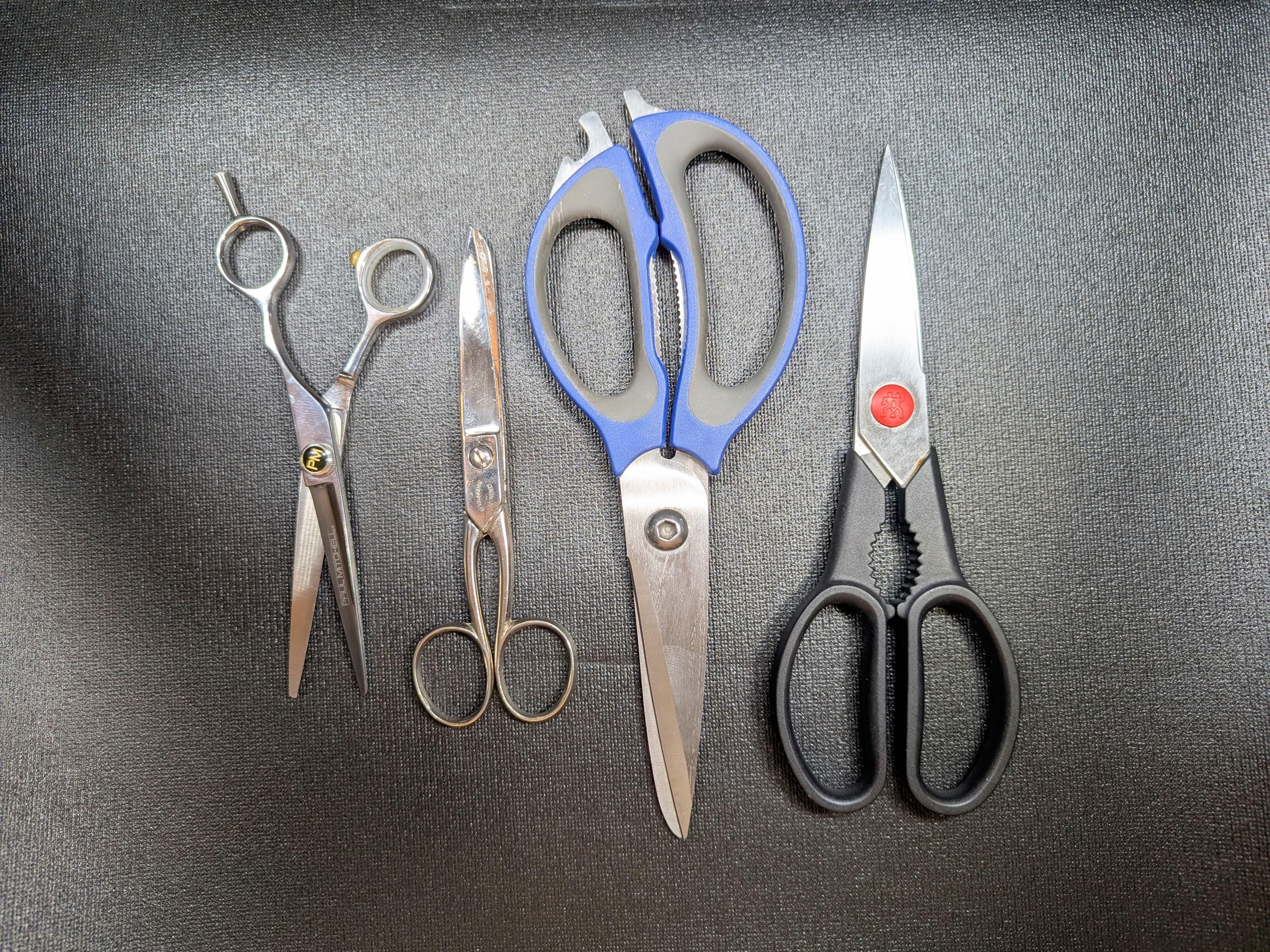
Scissors didn't start with a pivot. Around 1500 BCE, metalworkers in Mesopotamia and Egypt forged a single strip of bronze into two blades joined by a springy, C-shaped bow — squeeze to cut, and the bow's own tension snapped it back open. Roman craftsmen didn't improve on that for another 1,400 years or so, when they crossed two separate blades on a central rivet instead, turning the tool into a lever: move the pivot toward the tips and a user's grip strength multiplies. Without a spring to reopen the blades, the handles picked up their now-familiar finger rings.
The Evolution of Scissors
As European guilds and Japanese smiths refined iron and steel forging, the one tool split into two: scissors, short and straight for fine work, and shears, longer and often offset for the leverage heavier cutting needs. Sheffield's Robert Hinchliffe brought cast steel and mass production to the trade in 1761; sidebent handles later let tailors cut fabric flat on the table instead of lifting it off; and by 1967 Fiskars paired stainless steel with a molded plastic handle — the shape still behind most scissors in the drawer today.
Yard Tools
A Long History
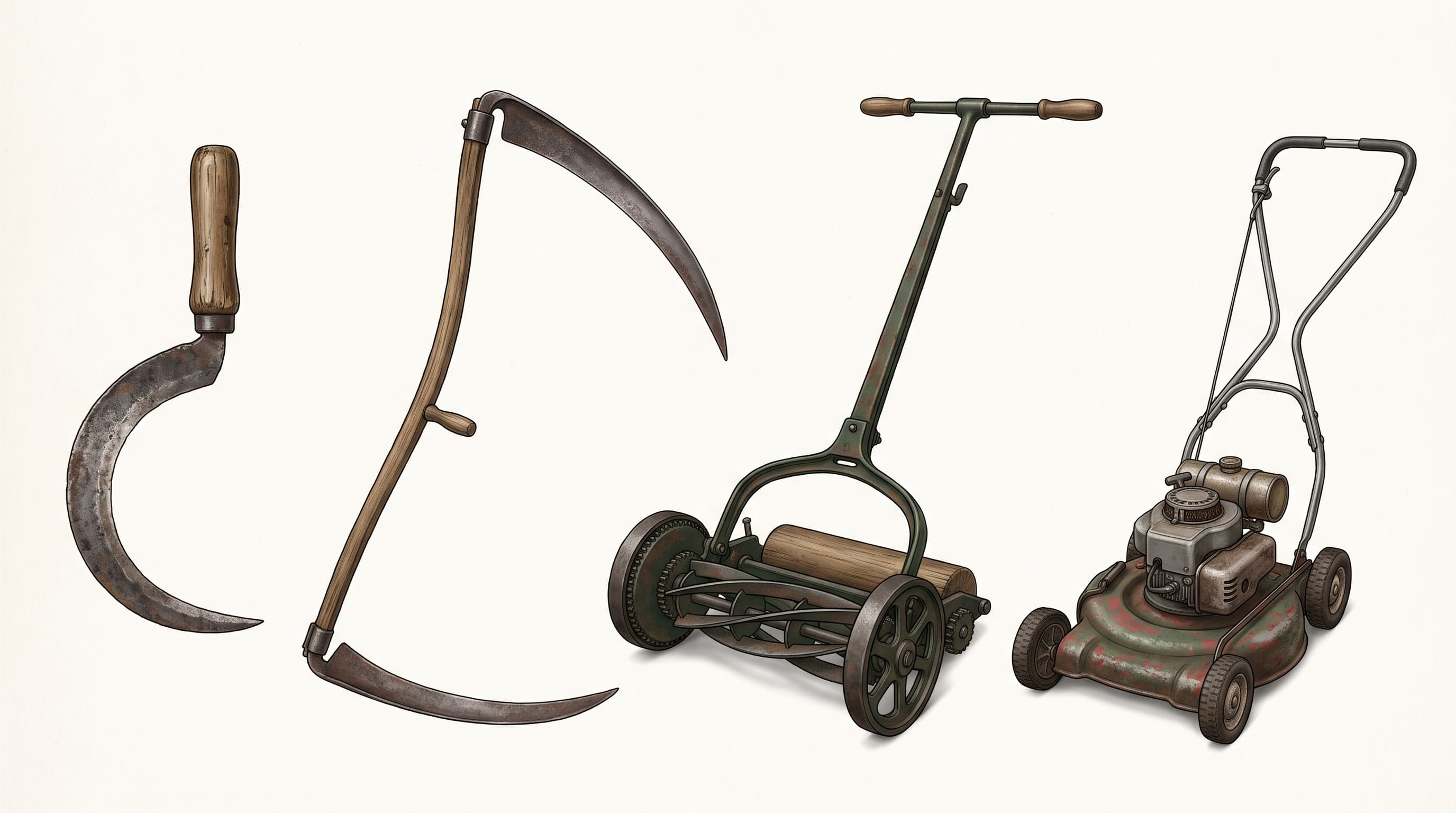
Before there was a lawn to mow, there was a field to clear — and for most of farming history, that meant a curved blade swung by hand. The scythe and sickle go back to the Bronze Age; Roman vineyard workers pruned with the falx vinitoria, a single heavy hooked blade pulled toward the body to cut vines without the awkward wrist angles (and the occasional sliced finger) that came with it.
The hoe split into its own two philosophies early on, too. Ancient Egyptian and Mesopotamian farmers chopped crusted soil with a wide blade set near-perpendicular to the handle — still the draw hoe's shape today — while Dutch market gardeners, centuries later, found that a thin blade pushed nearly flat just under the surface could sever a weed's roots without dragging dormant seeds up to sprout.
The Evolution of Yard Tools
The hand tools kept refining long after the hooked pruning knife. In 1815, French agriculturist Bertrand de Molleville built the first spring-loaded secateurs — a curved blade sweeping past a hooked counter-blade, scissor-style, to slice green wood without crushing it. In 1923, German inventor Walther Schröder flipped the mechanism for dead or woody stems: his anvil pruner closes a straight blade onto a soft-metal block instead, trading a clean slice for crushing force. Both shapes are still what you'll find in a pruner aisle today, alongside the stirrup hoe (a hinged, double-edged loop that slices weeds on the push and the pull) and the Japanese hori-hori, a part-trowel, part-blade dig tool built to pry stubborn roots out of rocky ground.
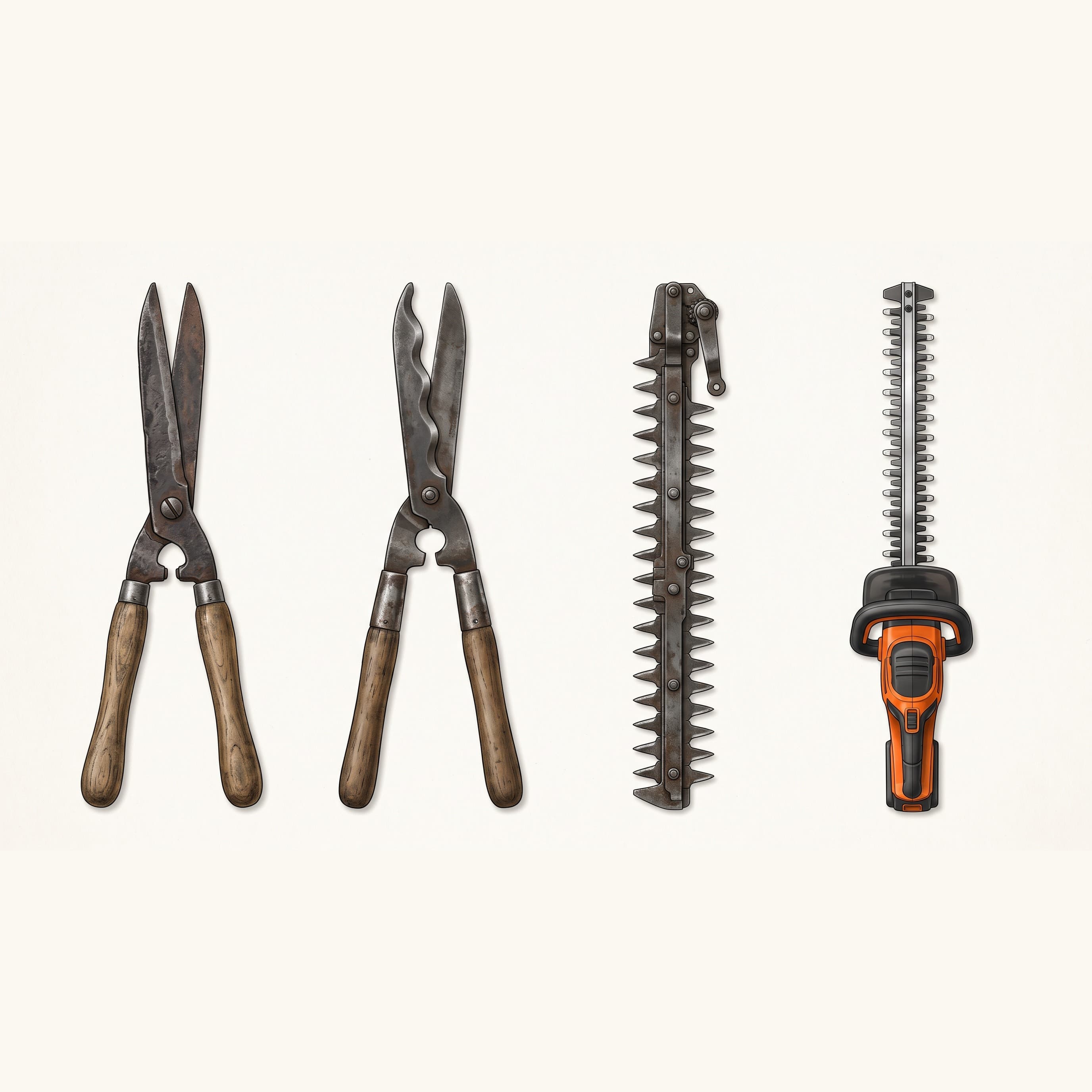
Lawns and hedges mechanized on their own track — the push mower gave way to the gas rotary blade, hedge shears gave way to reciprocating power trimmers, and the chainsaw turned a two-person felling job into an afternoon's work. Every one of these tools, hand or power, still depends on a sharp, true edge to do its job without tearing the plant or straining the motor — and it's easy to let a mower blade or a pruner go dull until it's visibly chewing instead of cutting. We true up the bevel and get bypass pruners, anvil pruners, loppers, and reciprocating blades back to cutting cleanly.
Woodwork Tools
A Long History
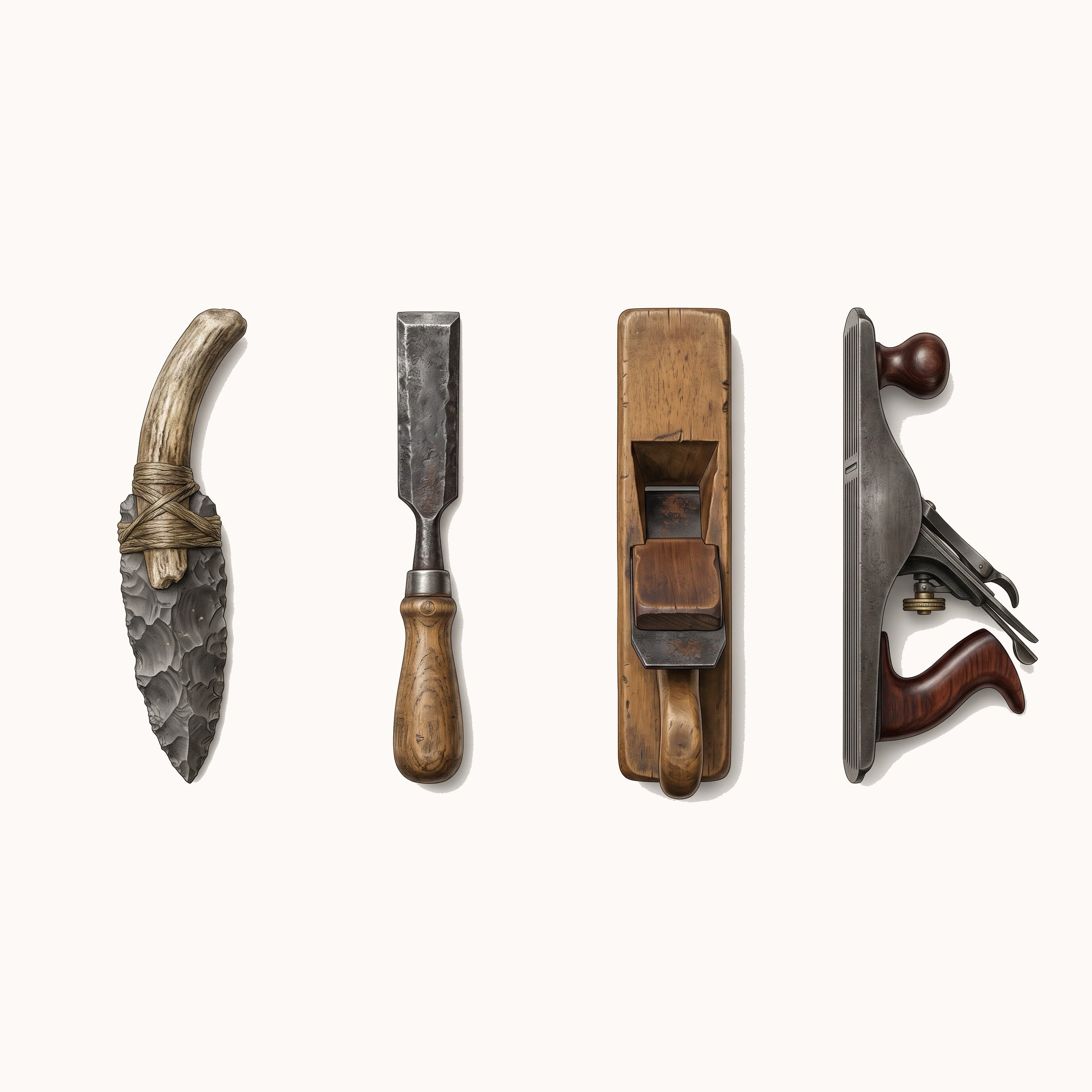
A chisel is one of the oldest tool shapes there is — Neolithic woodworkers were knapping flint and grinding greenstone into chisel blades to hollow dugout canoes before anyone had smelted metal. Once Bronze and Iron Age blacksmiths could forge and temper steel reliably, the one shape split into specialists: thin paring chisels light enough to slice a dovetail by hand pressure alone, mortise chisels thick enough to take a mallet blow and pry out waste, and gouges ground curved — on the outside for hollowing a bowl, on the inside for scribing a tight molding. Japanese smiths took a different path to the same edge, laminating a thin, ultra-hard cutting layer onto a softer iron back so the whole blade could flex without snapping.
Flattening a board freehand with a chisel takes real skill — tip the angle even slightly and it dives into the grain and tears out a chunk. Roman carpenters solved that by the 1st century CE, wedging a chisel blade at a fixed angle inside a block of wood — the first hand plane, examples of which have turned up at Pompeii. For the next 1,800 years, planes stayed wooden, the blade held by a tapered wedge, until 18th-century English makers added a cap iron just behind the edge to curl and snap the shaving before it could split ahead of the cut.
The Evolution of Woodworking Tools
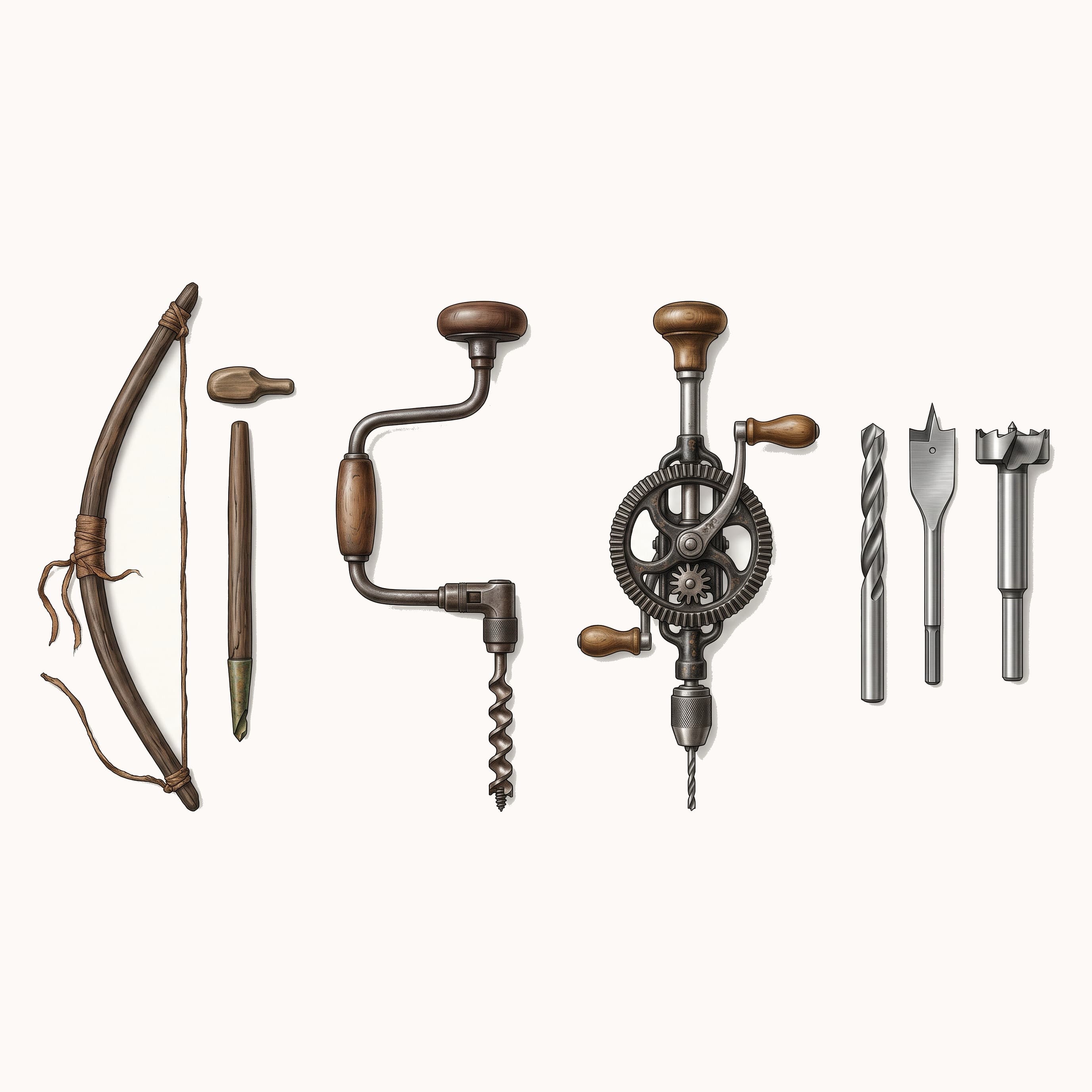
Boring a round hole had its own slow evolution running in parallel. Egyptian furniture makers spun bronze points with a bow drill, the cord wrapped around the spindle and sawed back and forth; medieval shipwrights scraped out holes by hand with a T-handled spoon auger. English toolmakers sped that up twice over — the 1770s spiral auger used helical flutes to pull shavings continuously out of a deep hole while a lead screw pulled the bit into the wood on its own, and the 1860s geared "eggbeater" drill let a hand crank spin a thin bit fast enough to cut cleanly instead of snapping it.
The 1869 cast-iron plane — depth wheel, lateral adjustment lever, a sole machined dead flat — finally retired the wooden wedge-and-mallet-tap method for good, and modern tool steels (high-speed steel, A2, carbide) hold an edge under heat and friction that would ruin hand-forged iron in minutes. Power drilling split bits by job instead of era: twist and brad-point bits for fast, clean holes, spade bits for rough boring through framing, Forstner bits for flat-bottomed or overlapping holes a lead screw can't manage. We true up chisels and plane irons on the same fixed-angle and belt systems we use for knives, and get drill bits re-pointed instead of replaced — a sharp bit runs cooler, cuts straighter, and doesn't walk off your mark the way a dull one does.
Why Second Edge
No storefront counter to carve time out of your day for — pickup available, or convenient drop-off scheduled around your week instead. Every blade gets assessed before it touches a sharpening tool.
Only then do we determine how it's sharpened: diamond-stone, fixed-angle, belt, or Tormek's water-cooled system — all run by a craftsman who treats your edge like it matters, because it's the one you'll be using tomorrow.
Ready for a True Edge?
Instant quotes and online booking are launching soon: you'll be able to select your blade type, brand, and length for an instant quote, then choose a pickup/drop-off day. In the meantime, get in touch and we'll get back to you promptly.